Showing posts with label Stage 1. Show all posts
Showing posts with label Stage 1. Show all posts
Sunday, November 30, 2008
Possible Developments
I was thinking about what we have so far, and I'm a little worried it won't take up enough time. This may not be an issue at all, but I thought that in case we need more, we could possibly have a bit of cross-cutting to the housemate, maybe sitting downstairs in the dark watching a horror film - we wouldn't see the TV but would see her on the sofa in her PJs with a mug of tea or something, looking a bit scared, with the light of the TV flickering over her face, in conventional horror-style. She can mention it later during the conversation - 'I was just watching Pyscho' or something. I think something like this might help to build up the suspense and tension a little more.

Tuesday, November 25, 2008
Thoughts
I like how our idea has developed a lot from our original concept, which, although I liked, I felt was going to have a lot of complications but maybe not be that interesting. However, I think everyone's been making really good contributions to bring it along, and we've expanded a lot on certain ideas and had better ideas about how to show things and what shots to use - but it has got a bit too ambitious at times - Mrs Blackborow's feedback included that, although the beginning twist is good, it's a lot to fit in and be taken in by the audience in just two minutes, which on reflection I realise could be a problem, and we'll have to think hard about how we can get around it - i.e. not putting in too much to take in, but enough to deliver enough information. So I guess we'll see how that develops!
Individual Treatment
Film Opening Idea:
Basic Plot - it's coming up to Valentine's Day, and police have noticed connections in a series of murders. They don't know it yet, but the killer is a young woman whose boyfriend cheated on her with her best friend - she's out for revenge and goes out killing unsuspecting beautiful young women whom she sees as threats. The girlfriend of the detective working on the case is killed on Valentine's Day, when he was going to propose to her...
Opening - the killer is getting ready to go out - at this time the audience thinks she's going to be going out clubbing or whatever - there is cross-cutting to a girl who's been out and is coming home, has left her friends, is walking down an alleyway quickly... the killer comes up behind her (this would be a subjective tracking shot) and puts her hand over her mouth as the camera cuts to a CU of the victim and we see the face of the first girl (killer) behind her.
Friday, November 7, 2008
DVD Cover Analysis

PULP FICTION - (Quentin Tarantino, 1994)
This is the DVD cover for the film Pulp Fiction which quickly gained cult status, was the tenth biggest film of 1994, and made it as a top-10 UK bestseller in book-form, meaning its screenplay was the most successful in UK publishing history.
The cover consists of a dark grey background, with white text at the top centre stating the production and distribution company (Miramax), and linking the film to Miramax, thereby linking it to previous successes from the company, and in turn linking the company to the success of the film. The DVD logo is also in the bottom left-hand corner in white.
The cover's image is enclosed by an oblong, outlined in white, with a black background, which is stylish and connotes mystery, as well as emphasising the central image. Centred at the top is small white text, which says [I think] 'A FILM BY QUENTIN TARANTINO', before the film's title in big, bold, yellow letters, in a comic-book style font. This relates to the title of the film itself, Pulp Fiction, referring to fiction originating from a pulp magazine (a magazine made with cheap paper and low printing costs, which contain fictional shocking or sensationalist stories by low-paid writers). On the magazine theme, there is also a section in the right-hand corner of the image that is red, outlined in white, as though part of the front has been torn off revealing this colour underneath on a different page. The colour red also connotes passion, blood and therefore danger & violence, and anger. It also suggests that there may be many layers to the plot, and stories within the story, in the same way that a magazine contains a lot of different stories.
At the bottom of the image is a credit block with the names of the stars of the film, all successful actors, with the most famous in the most prominent places, meaning the eye of the viewer is drawn to them first, and again, their past successes are connected with the film, as well as helping the audience identify what kind of film it may be. The audience classification is rated as an 18 and the symbols to show this is in the bottom right hand corner.
The main image itself consists of Uma Thurman, who plays the character of Mia Wallace, lying on her front, leaning on an orange cushion, with her legs crossed in the air behind her. In this way we can see her shoes, black high heels, and black outfit, which is only stopped from blending in completely with the background by the reflection of light on the lower half. She has short black hair with a fringe, and is wearing make-up and nail varnish which can both be seen from the image, and she is shown to be a sexy character, from her positioning and dress code. The shot uses direct mode of address, and she looks as though she has been interrupted by the viewer, with a slightly annoyed, bored, and contemptuous expression. With one hand, she is holding a lit cigarette, and the other hand is flat on a magazine, cover facing outwards, placed this way so we can see on the front 'Pulp Fiction', which once more links to the magazine theme, not only by having a magazine in the image, but with the reference to the film's title. The fact that she has put the magazine face-down also shows she is concentrating on the person who has just walked in or approached her. Both these things also make the character look fashionable and 'cool'. It could be understood that she is, in fact, just posing, because she is not holding the magazine particularly tightly, rather just resting her hand on it. It could also be understood as a state of readiness, where she is prepared to pick up the gun.
Against the orange cushion, we can see a gun, with light reflected off it - without the cushion, it would blend in with the background. The fact that it is so casually placed and that its presence seems to have no effect on Mia shows that it is something she is used to, again giving the audience the idea that the film is going to contain violence. It also connotes that she is quite a dangerous character. Below the gun is a packet of cigarettes, though it's hard to tell in this image - the image from the cover would be widely recognised by most people, as it's a less detailed version of the image on the original, highly iconic, poster for the film (click here to see it!). The poster is even more in the style of a cheap magazine - it has a price of 10¢ on it, and it has a faded, battered look about it, and the poster is, overall, highly successful in helping to create the narrative image for the film and promote it.
Tuesday, November 4, 2008
Music!
From the same series of clips about the making of Sweeney Todd, this one says a bit about the music in it, which I found quite interesting and fun to watch. Plus I like the clips from the film! Enjoy :)
'Sweeney Todd: The Demon Barber of Fleet Street'
I feel that these videos, about Tim Burton's 'vision' of Sweeney Todd, are really useful and inspiring, giving information about all different elements in the film from a wide array of people involved - including actors, the composer, producers, the screenwriter, and Tim Burton himself, who directed the film.
The film itself, although classified under the genre of a musical, has elements of other genres too - it is a horror, but is also funny, using a lot of black humour. In the second clip [above], Helena Bonham Carter, who plays Mrs Lovett and is Burton's fiancé, talks about how "Tim's always loved horror movies", [as does Johnny Depp who frequently works with Burton and plays Sweeney Todd], and how they "looked back at their old favourites for a lot of inspiration".
CHARACTER

Sweeney Todd - played by Johnny Depp
Sweeney Todd started out as Benjamin Barker, a barber, living happily with his beautiful wife Lucy, and their baby daughter, Johanna, in Victorian London. However, Lucy's beauty catches the eye of Judge Turpin, who convicts Benjamin of a crime he did not commit and deports him to Australia.
On his return to London fifteen years later (which was illegal and accomplished with the help of Anthony, a young sailor), he learns from Mrs Lovett, owner of a (highly unsuccessful) pie shop and an old friend, that after deporting him, Judge Turpin raped his wife, and she then poisoned herself and is dead. Johanna was put into Judge Turpin's care. Benjamin tells Mrs Lovett that he's not Benjamin Barker anymore, but Sweeney Todd, and he reopens his barber shop above Mrs Lovett's pie shop. With Mrs Lovett's help, he plans to rid London of the corrupt aristocracy, wreaking his vengeance upon them and particularly Judge Turpin, by luring in unsuspecting victims to his barbershop before cutting their throats and delivering the bodies to Mrs Lovett, who uses them for her meat pies - which are hugely successful with her unknowing customers...
Todd is a character who has had a deeply traumatic experience, and cannot find happiness again. He chooses a path of revenge, which only makes him worse. All his experiences and emotions are conveyed extremely well through Johnny Depp's fabulous acting and the appearance of the character, involving costume and makeup. Todd is one of those Tim Burton characters that sticks in your head and creates a lasting impression, and the mise-en-scène of the whole film fits his mood - e.g. at the beginning of the film, when his blissful life before his deportation is shown, the lighting is much more high-key, the saturation is higher, and brighter colours are used - there are pretty flowers and even Todd's suit is a brighter, warmer shade of brown. When he returns to London in his misery, his life ruined, the colours are all cold and are mainly shades of grey, brown, blue, and white, which really reflects his mood.
The Demon B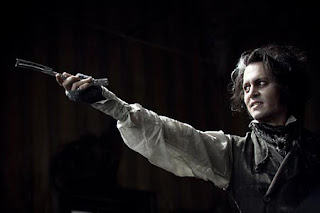 arber's Look
Todd is instantly recognisable - firstly, he's played by Johnny Depp, who has a great talent in adapting to his different roles and making the audience forget previous characters he's played in his new role. Costume-wise, his hair is wildly unkempt (though of course, he is clean-shaven), and has, as stated in one of the videos, a Bride of Frankenstein style white streak running through it. His face is made to be very pale, with his eyes emphasised, as is Mrs Lovett [see below]. His costume is kept to dull, cold shades.
 arber's Look
Todd is instantly recognisable - firstly, he's played by Johnny Depp, who has a great talent in adapting to his different roles and making the audience forget previous characters he's played in his new role. Costume-wise, his hair is wildly unkempt (though of course, he is clean-shaven), and has, as stated in one of the videos, a Bride of Frankenstein style white streak running through it. His face is made to be very pale, with his eyes emphasised, as is Mrs Lovett [see below]. His costume is kept to dull, cold shades.
He is clearly a very disturbed character, unsurprisingly, after everything that has happened to him - not too long into the film Judge Turpin decides to marry Johanna - yet he is still attractive, particularly to Mrs Lovett, who fantasises about the two of them being together - something which plays a part in the twist in the film. What Todd wants most is revenge, and he strikes out at his corrupt aristocratic customers, killing a great deal of them, but he wants to get his hands on Turpin, the one who ruined his life. This desire, this need for revenge fuels his madness and he ceases to think about his actions, ultimately leading to his chilling demise at the end of the film, when he feels he has been betrayed and used by Mrs Lovett.
His relationship with her, though she would like it to be something more, is never seen by him to be a lot more than a matter of convenience and partnership in crime, because he will never stop loving Lucy, who is dead...
Todd is a very intriguing and, despite being a murderer, quite likeable character, as audience sympathy is created for him, as we know the whole story. The film is about him, and so he needs to have the qualities of creating this enigma, in order to attract the audience to want to find out more, which I feel it does very successfully.
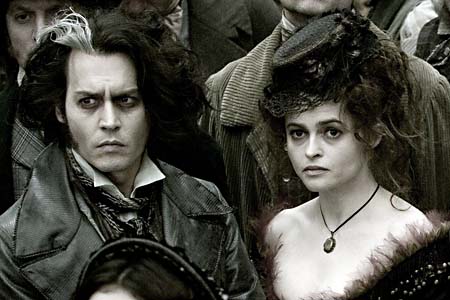
Sweeney Todd & Mrs. Lovett
Monday, November 3, 2008
Directors again!
 David Fincher (28th August, 1962-present)
- filmmaker and music video director
- tends to make dark, stylish movies
- often focuses on psychological
- has worked often with Brad Pitt, e.g. in Se7en (1995), Fight Club (1999), and The Curious Case of Benjamin Button (2008)
- has been nominated for/won numerous awards, the most illustrious of which include:
- Golden Globe nomination for Best Director - Motion Picture for The Curious Case of Benjamin Button
- BAFTA Film Award nomination for Best Director for The Curious Case of Benjamin Button
- Oscar nomination for Best Achievement in Directing for The Curious Case of Benjamin Button
- won the DGA (Directors Guild of America, USA) Award for Outstanding Directorial Achievement in Commercials in 2004
- nominated for the OFCS (Online Film Critics Society) Award in 2000, for Best Director with Fight Club, and in 2008 for Best Director with Zodiac (2007)
Directors again
 Baz Luhrmann (17th September 1962 - present)
- Luhrmann was born Mark Anthony Luhrmann, and was given his nickname 'Baz' because of a resemblance to Basil Brush...
- like Burton, Luhrmann has a distinctive style
- he has drawn influence from Grand Opera/Italian Grand Opera in his works, particularly Moulin Rouge! [one of my favourite films!], and it really comes through, e.g. in his openings with the huge stage curtains
- he's worked with Nicole Kidman a few times
- films he has directed:
- Strictly Ballroom (1992) starring Paul Mercurio and Tara Morice
- Romeo and Juliet (1996) starring Leonardo DiCaprio and Claire Danes
- Moulin Rouge! (2001) starring Nicole Kidman and Ewan McGregor
- Australia (2008) starring Nicole Kidman and Hugh Jackman
- he was nominated for Directors Guild of America and Golden Globe awards for Best Director - Motion Picture for Moulin Rouge!, which also received an Oscar nomination for Best Picture
Directors
 Tim Burton (25th August, 1958 - present)
- he has his own unique, quirky style - his films tend to be quite dark and gothic
- his characters are always very interesting, and their quirks make them very memorable
- he is imaginitive and original
- his films are both fun and clever
- Burton often works with actor Johnny Depp, and actress Helena Bonham-Carter (with whom he has a son), who are both very talented and I really love
- amongst many others, [including animated films such as Corpse Bride (2005) which he also animated for, like The Nightmare Before Christmas (1993)], directed:
- Edward Scissorhands (1990) starring Johnny Depp
- Sleepy Hollow (1999) starring Johnny Depp
- Sweeney Todd: The Demon Barber of Fleet Street (2007) starring Johnny Depp and Helena Bonham-Carter
- and due to be released in 2010, Alice in Wonderland, which I'm incredibly excited about because I love Alice in Wonderland!
- he's won and been nominated for many Oscars for a large proportion of his films
Saw 0.5
This is the original short film that I mentioned two posts ago upon which 'Saw' was based. It begins with white noise as you'd get on a television screen - in itself this is a little unsettling, as it has become associated with horror (in 'The Ring', the film 'White Noise', and others) and generally a loss of communication, giving connotations of isolation. As well as this, it links to the video played later in the story. However, there are only about 2 seconds of this white noise! After that, we see lots of graphics that we can just make out to be blueprints of some kind of contraption cut one after another at high speed, while tension is build using an accompanying sharp, non-melodic sound, which increases in pitch and bears a resemblance to the sound of a tape being wound on fast-forward. After this we again have a fleeting shot of a 'snowy' screen. This is replace with a white screen, on which the title 'SAW' is punched in red letters, one by one, whilst in the background the music has changed to percussion with a low, minor strings underneath it, which are interrupted when once again the blueprints and 'snowy' screen image returns. The image cuts to CU of an ashtray with a cigarette in it, the packet and a cup in the background. A hand comes into the shot and picks up the cigarette, at which point there is a cut to a MCU of a detective, then to a MCU of the man smoking the cigarette. It is high-key lighting but with a cold tone - blues, greys, and whites. He has blood on his face, his clothes are looking worse-for-wear, he is handcuffed and he looks very shaken, with one arm crossed over himself in a defensive position. The camera moves out so we see more of the man, whose name we now know is David, and some of the table. As David mentions the photos, there is a cutaway to a photo on the table of a sinister looking chair, then to a syringe in an evidence bag, and the camera pans to a photo of a scalpel surrounded by blood. The camera cuts back to the arc around the table, where it has come to rest in position framing an OTS MS of David. The detective asks him for his story, and there is a cut to a CU of the detective. Back to the OTS shot, and David begins his story, putting his cigarette to his lips. There is a flashback, starting with a graphic match to the previous shot, as David is lighting a cigarette, which makes the transition much smoother. The music we heard in the opening titles starts up again, and we have a mini-montage of him getting ready to leave the hospital. He bumps into a nurse, who tells him to put out his cigarette, and he says he is - he's taking it out with him. There are good match-on-action shots here, demonstrating good use of continuity techniques. The nurse tells David the cigarettes will kill him, to which he replies 'living is overrated'. There is a small track and a pan as the camera follows David towards the lift and he puts on headphones, at which point the music we'd been hearing becomes diegetic, coming from his headphones. However, it slowly fades out, and is replaced with an eerie, atmospheric sound, similar to that of an arriving lift, but that the audience will probably attribute to whoever is approaching him from behind. We get this impression from the slow forward track to David's back that acts as a POV shot. A hand comes into shot and taps him on the back, and he turns and is knocked out. The effect of this is created using a fade-out to bright white, followed by a quick fade back in to a MS of David in the interrogation room, ending the flashback. As David talks, the camera very slowly, almost unnoticably zooms in closer, with occasional cuts back to the detective, ending on a BCU and another flashback, this time created with a small tilt upwards and a dissolve into the image of a 'snowy' screen and white noise, which in turn dissolves into a shot featuring the top half of David's head - another graphic match creating a smooth, effective transition. Here, however, the lighting has a green tinge to it and is low-key, and David has some kind of contraption attached to his head. He looks down at it and starts to panic, and the accompanying sound is parallel to this - high pitched, frantic strings with no tune. The camera reverse tracks to a MLS and we can see he is in some kind of cell and tied to a chair. Cut to an EHA ELS of the whole setup, which acts as an establishing shot. There is the sound of thunder and we get the effect of lightning, before a cut to an ECU of David from the side, so we can see the contraption better. He is panicking and confused, and looks around the room while the camera arcs around him. Lights flash, and he struggles to free himself, which we see at various shot distances. The audience is given a glimpse of the back of the contraption, where a timer is fitted. This creates suspense - we don't know when it will be set off, if the timer has started yet, etc., and David is unaware of its existence. Suddenly the television flickers to life and the image of the puppet appears. It is highly disturbing because puppets were originally toys to amuse children, but this one is grotesquely caricatured, and coloured only with black, white and red. When applied to this situation, it is a very chilling image, particularly when it starts to speak. It turns to the camera, as though it is inside the television looking at him. [Although the voice is quite creepy, it did at some points remind me of Bruce the vegetarian shark from 'Finding Nemo'... not sure why, perhaps just the Aussie accent?] The puppet greets David with his name, and says 'I want to play a game', again, playing on the children theme, the sense of fun and innocence, and subverting it completely. He explains how the device attached to David works, and gives a demonstration. The timer on the 'reverse bear trap' in the video goes off, and we hear ticking, like that of a clock; there's a cut back to the establishing shot, and then see what the device does in the video. The puppet tells him there's a key to the device - in the stomach of his dead cellmate - and that he has to make his choice - live or die. The video ends and at this point (5:11 minutes into the clip) David goes into a complete frenzy, panicking like mad, which is echoed and transferred to the audience by the use of editing here - jump cuts and under-cranking are used, and quick cuts between a MS of him in the chair to closer shots, where the camera arcs around, and they are faded together. Again, the music is parallel, with a screeching sound & what we associate with electricity. In his frantic desperation, he frees himself - and in doing so, triggers the timer. He realises with horror, and we get a cutaway to the timer, and hear the ticking sound. Again he panics and tries to pull it off his head, but fails. The lights in the room are flashing, adding more horror to the scene. The flashback ends again with a cut back to a CU of David, who looks extremely disturbed and agitated. The detective is presumable reading his statement and explains that that's when he saw the body - cue flashback, but done with a simple cut this time, to a handheld camera tracking David. This scene is really chilling, as just as David finds the scalpel and is about to cut into the body's stomach, he realises the man is, in fact, not a corpse, but has been put under paralysis. The man pleads with his eyes, but we can tell that David is fighting with himself to do this because he doesn't want to die - these shots are interspersed with cutaways of the timer. The frenzied strings are back, building tension once more. At the moment he raises the scalpel, the flashback ends again. When we return to the flashback, we see the shadow from the flickering lights of David cutting into the man, more cutaways to the timer, getting ever closer to the end, and his bloody fingers as he finds the key, and it gets tenser and tenser - will he get it off in time? [of course, we know he does because we've seen him alive and ok in the interview, but we don't think about this in the suspense and excitement of the moment]. He gets it off just in time as it snaps open, and we have a MCU of his blood-covered face and hands as he screams and sobs at his ordeal. Then the figure from the video enters the room on a squeaky tricicle - another child's toy - and congratulates him. The explanation we are offered for the actions of David's tormentor is that 'most people are so ungrateful to be alive, but not [David]. Not any more.' [This reminds me of the scene in 'Fight Club' with Raymond K. Hessel - Tyler threatens him with a gun and makes him think he will kill him, then lets him go, but tells him to go out and become a vet, as he had wanted to do. He says the next day will be the best day of Raymond K. Hessel's life.] The flashback ends with a dissolve back to the interrogation room, and once again the camera moves from David to the back of the detective, creating an OTS shot, where the detective asks him, 'are you grateful David?', at which point David completely breaks down. The film ends with a fade to black, and to an old, derelict bathroom, where the camera zooms towards the end wall, where a hole appears and an eye can be seen looking through. The title 'SAW' appears again, the 'A' where the eye is, and music is once again what we heard in the opening. The shot cuts to black and the credits begin.
Making of 'Sweeney Todd' - Costume Design (1/2)
I was doing a bit of research into costume, and I thought of 'Sweeney Todd: The Demon Barber of Fleet Street', directed by Tim Burton, 2007, as a film with its own unique mise-en-scène and style - like all Burton's films. So I looked it up and I found all these great videos about the making of 'Sweeney Todd' on Tim Burton's YouTube, including costume design. I'm going to post a couple onto my blog so you can see it all yourself :) Love it!!
Horror Films
Horror Films I've Seen

Psycho (Alfred Hitchcock, 1960)

I Am Legend (Francis Lawrence, 2007)

Shaun of the Dead (Edgar Wright, 2004)

Final Destination 2 (David R. Ellis, 2003)

Final Destination (James Wong, 2000)

Sleepy Hollow (Tim Burton, 1999)

Mary Shelley's Frankenstein (Kenneth Brannagh, 1994)

The Ring (Gore Verbinski, 2002)

Misery (Rob Reiner, 1990)

Saw (James Wan, 2004)
Ok, it's not many, but it's more than I'd thought I'd seen :D I've chosen images from each film that I feel show some of the scariest/most disturbing moments or themes, e.g. Samara climbing out of the well, from The Ring, the Headless Horseman (but with his head...) from Sleepy Hollow, and of course the infamous sledgehammer scene from Misery, where Annie Wilkes "hobbles" Paul Sheldon by breaking his ankles. I also chose an image of the really creepy puppet from Saw, which originated with Saw's origins as a short film and delivers the rules of the 'game' to the victim.
Genre - The Way It Goes
Cycle, Series, & Franchise
(in horror)
(in horror)
CYCLE
1960 - 'Psycho', 'Peeping Tom'
1974 - 'Texas Chainsaw Masacre', 'The Omen', 'The Amityville Horror', 'The Exorcist'
1978 - 'Halloween' -> Michael Myers
1980 - 'Friday the 13th' -> Jason
1984 - 'A Nightmare on Elm Street' -> Freddy Krueger
1991 - 'Silence of the Lambs'
1996 - 'Scream', 'I Know What You Did Last Summer'
2007 - 'Scary Movie'
The above is a demonstration of the way the popularity of a genre rises and falls in a cycle. 'Scary Movie' is a parody of the horror genre - usually parodies kill off the genre because they can no longer be taken seriously, but this is not necessarily true.
SERIES - when a horror film has been successful, sequels are very often made - using examples from the above line, there have been sequels to most of them, e.g. Scream, Scream 2, Scream 3, and filming for Scream 4 will start at the beginning of 2009.
FRANCHISE - after the series stage, when sequels have clearly been successful and audiences have continued to go to see them, products are often sold that relate to the film, or are copies of props in the film, e.g. you can buy the Scream mask...
Genre
*GENRE*
gen·re –noun
1. a class or category of artistic endeavor having a particular form, content, technique, or the like: the genre of epic poetry; the genre of symphonic music.
2. Fine Arts.
a. paintings in which scenes of everyday life form the subject matter.
b. a realistic style of painting using such subject matter.
3. genus; kind; sort; style. –adjective
4. Fine Arts. of or pertaining to genre.
5. of or pertaining to a distinctive literary type.
Genre - usually referring to books, films, TV programmes, video games...
- grouping films by genre allows us to group them by similarities
- depends on how it is made and what it is about - characteristics, key feature, conventions
Categories of Conventions:
Characters: typical roles, characteristics, relationships, action & behaviour, names, costume etc.
Narratives: typical plots/structures, events & how they happen
Themes: typical ideas behind the story, what the film is about, the director's intentions for the audience, ways of thinking that the film inspires
Iconography: mise-en-scène, props, locations, colours, shooting, lighting and techniques
There need to be enough films with similar characterstics and key features for a genre to be created, e.g. horror. Sub-genres can only develop once a genre is very large, e.g. Zombie films are a sub-genre of horror, as they have similar characteristics but their own defining features too.
The key to making any genre film successful is REPETITION and DIFFERENCE - directors take elements of previous successful films & insert twists and breaks with convention. A film will probably be unsuccessful if it is too similar to another.
Formula for a successful genre film = familiar combined with the unexpected. There needs to be familiarity, or audiences can become confused. Word-of-mouth can undo initial successes of films which fail to meet the conventions of the genre they claim to be.
Films that cross genres [hybrids] often have several different posters advertising the film, each portraying a different genre within the film.
Genre films are much easier to target and market en masse than non-genre films, due to the power of expectation amongst audiences. Non-genre films tend to be more difficult to decode & therefore be enjoyed, which is one thing that can limit their mainstream appeal.
For producers and directors, using genre conventions helps films have a higher popularity and familiarity with audiences, and helps them to target & market the film. The risk factor is reduced with the use of previously successful elements too.
For audiences, genres help inform what they like and therefore what films they want to see, which stems from the expectations of certain genres - as audience members, we know generally what we do and don't like and so tend to go for what we know when choosing films - we look for the familiar. These are called 'predictable pleasures'.
However, categories are not as stable as they look; there is not one for everything. Genre theory is useful but if you look at it too closely and try to play around with it too much, it doesn't really work.
Sunday, November 2, 2008
Filmmaking Tips
I was having a look for some good tips for making a successful film, and I did find this, but I'm not quite sure I'll manage the beard... BUT I found a rather useful website (which you'll find in my links list over on the right :D), with tips under 9 headings - script, pre-production, casting, rehearsals, equipment, production, directing, keeping everyone happy, and editing. So there's quite a lot to choose a top 10 from, but I've given it a go..
~
* TOP 10 FILMMAKING TIPS *
- Script - get to know your characters; make up a backstory for them. Whether or not it features in the film is irrelevant.
- Pre-production - do location scouting, and do a location recce to make sure everything's fine before filming day.
- Casting - when auditioning your actors, get them to read a monologue or a scene from your script twice. The second time, give them direction on how to read it. See if they follow your directions; if they don't, they probably won't on set either.
- Rehearsals - if you have a limited rehearsal schedule, go for the most difficult scenes to film, such as those with lots of movement or long shots [as in time, not distance].
- Equipment - always have the appropriate emergency equipment!!: extra battery, tape cleaner, lens cleaner, AC adapter etc.
- Production - a lot of time is spent moving around between sets, so once the camera, mic, and lighting is set up, shoot everything with that setup then before moving on.
- Production - avoid shooting with audio outside around any day where there is likely to be some kind of background noise, e.g. Guy Fawkes Night when there will be lots of fireworks, and if you have to, keep the takes short.
- Directing - when things go wrong (which they will) don't lose your cool; the cast & crew look to the director to keep everything together. Think of a backup plan and do that, and when you make a mistake, admit it.
- Keeping everyone happy - always have food and drink on the set that accomodates everyone, & take lunch breaks on longer days.
- Editing - don't edit alone; if you edit by yourself and don't allow feedback along the way, your film may look great to you but the audience might hate it. Make sure the people helping you edit aren't afraid to point out things they think could be done better, as the movie is ultimately better through compromise.
More Contrapuntal Sound
This is a clip from 'Good Morning, Vietnam', a film from 1987 directed by Barry Levinson. I haven't seen the film, but I found this clip when I was looking for the use of contrapuntal sound in films.
In this clip, it comes when Williams, who plays Adrian Cronauer, a new DJ for Armed Forces Radio, plays Louis Armstrong's 'What a Wonderful World' for the troops heading into danger. We see cross-cuts between the troops setting off on their journey and the Vietnamese people going about their everyday lives peacefully and calmly. 1:05 minutes into the clip, we see a handheld pan on a helicopter, and then there is a montage of clips of devastation and destruction, and the 'trees of green' next to homes being blown up and burnt, whilst over the top, 'What a Wonderful World' is still playing. While we see an image of an angry protest and the clash between the protesters and the police, we hear the lyrics 'I see friends shaking hands saying "how do you do"; they're really saying "I love you"' - the music couldn't really be more contrapuntal to the action, and it makes the sequence much more effective.
Contrapuntal Sound
These are some examples of the use of contrapuntal sound in film sequences.
Face/Off (John Woo, 1997)
Example found 3:56 minutes into the clip - Somewhere Over the Rainbow, a calm, peaceful song with idyllic lyrics about dreams coming true etc., is playing in the boy's headphones (so is diegetic) whilst around him a fight scene is in full swing, with guns being fired, things being smashed to pieces, and people dropping dead all over the place - the music is completely contrapuntal to the action.
Trainspotting (Danny Boyle, 1996)
This is the opening sequence for Danny Boyle's Trainspotting, in which the main characters are introduced and the situation set up, and Renton explains, by means of a voiceover, that instead of 'choosing life', they have chosen to live in 'a blissful, meaningless heroin-induced stupor'. The music accompanying this sequence is Iggy Pop's Lust For Life, the lyrics of which are contrapuntal to the actions - for example, from about 2:30 minutes into the clip, as we get the lyrics 'no more beating my brains with liquor and drugs', Sick Boy is injecting someone with heroin.
In the next part, Habanera from Carmen Suite No. 2 is playing, as Renton talks about 'relinquishing junk' and prepares himself to go cold turkey, which includes getting three buckets to essentially use as toilets. The music is contrapuntal - coming from an opera it has associations of class, elegance, and luxury, which does not match to the scene at all.
On an unrelated note, there's a nice graphic match when Renton gets hit in the head by a ball at 1:12 minutes in, and there are cross-cuts to him at home falling down as he does on the football pitch (mainly at 1:16-17 minutes).
Saturday, November 1, 2008
Sound
* S O U N D *
DIEGESIS - the 'world' of the film and the elements belonging to it.
DIEGETIC SOUND - sound which is part of the film's world, even if it is added in the editing process, e.g. a door slamming, footsteps, an explosion...
There are two types of diegetic sound:
ON-SCREEN - sound that we hear that originates from something happening in shot, e.g. someone who is in shot speaking. We hear the sound and see what's making it.
OFF-SCREEN - sound that we hear that originates from something happening out of shot, e.g. the phone or doorbell ringing; or someone going to make a cup of tea, leaving someone else alone in the shot, but we hear their half of the conversation and the kettle boiling and spoons and mugs clinking. We hear the sound but can't see what's making it.
The usage of both on-screen and off-screen sound helps to build a three-dimensional world for the audience, and makes it easier to forget they're viewing images on a flat screen. Off-screen sound can be used to inform us of events and settings, e.g. we might hear shouting in another room, and know that people are having an argument; if we hear a police/ambulance/fire engine siren, we can deduce that help is coming, and the place is by a main road; we might hear the sound of lots of traffic, and know that we are probably in an urban location.
NON-DIEGETIC SOUND - sound which is not part of the film's world and has definitely been added during the editing process. If you were in the film's world, you would not be able to hear it, e.g. the voice-over of a narrator, or orchestral music that's not being played by someone in the film - soundtrack but not SFX. Music can be diegetic if it's coming from a radio, jukebox, stereo etc.
FOLEY TRACK - the diegetic soundtrack, created by foley artists. Foley artists enhance sounds and create them (if it's a CGI) after shooting - basically sound effects, e.g. footsteps, rustling, a dinosaur hatching from an egg, a gunshot made louder... Click here for an insight into the art of foley...
SOUND BRIDGES - when the sound from one scene overlaps into the next scene. Sometimes the sound from one scene continues into/over the next scene, so the images change but we still hear the sounds from the previous scene. More often than that, the sound from the next scene starts before we see the relevant images, so we hear the sounds from that scene before we see the images.
This makes the narrative flow; without sound bridges films would be very disjointed, because they give the film a sense of linking, creating a wider and coherent diegetic world. In this way, sound bridges are a factor in the film's continuity.
PARALLEL (SYNCHRONOUS) SOUND - when what we see matches what we hear. In a film, the sound usually complements what we are seeing, e.g. happy music at happy moments, sad music with sad images, and exciting music for exciting scenes. The mood of the music matches the action on the screen, which is why it is called parallel sound (a.k.a. synchronous sound).
CONTRAPUNTAL (ASYNCHRONOUS) SOUND - when what we see does not match what we hear. Occasionally during a film, the sound does not seem to match the action, e.g. in Jaws, when we see images of people happily relaxing on holiday on Amity Beach, but hear the famous sinister motif of Jaws, which doesn't fit in with what we see, but by this point know to associate it with the arrival of the man-eating shark. This is contrapuntal (meaning 'at a counterpoint to') sound (a.k.a. asynchronous sound), and can be a very effective technique.
Film Trailer: Mirrors (2008)
As I'm sure you can see this is the trailer for the horror film 'Mirrors' which is out at the moment, based on the 2003 Korean film 'Into The Mirror'. To be completely honest, the trailer actually scared me quite a bit, particularly the last segment; I am pretty easily scared but I think this was effective, although I'm sure it helped that I watched it in the dark... And I'm going to see the film later. Aagh! Aaaanyway, what I'm going to talk about here is what makes the trailer so effective - apart from me being a bit scared of everything.
The trailer starts off with a fade into a nice establishing shot of a lovely house in a lovely neighbourhood, and the main characters and their family situation is set up, and there is quiet music. It's high key lighting and normal cuts. We then have a fade, showing us time has passed and introducing us to a new setting - the man from the previous sequence of shots getting out of a car and walking towards something, before another fade to another establishing shot, this time of an enormous, derelict building. With another fade we see presumably the inside of the building, with an ELS of a set of stairs and two people standing on them. This now has low-key lighting and is getting more sinister as we hear dialogue over the top of the shots. The use of fades gives the sequence a fairly slow pace, and we don't have too much to take in, so we can listen to the speech, which explains that the man who previously had this job was obsessed with the mirrors. This is the first connection to the title of the film and what it's about, making it a good time for a dissolve into the 20th Century Fox logo - the image of which has oh so cunningly been mirrored, as has the next image, the Regency logo. The music starts up and on the next shot of the actual film we hear those high pitched, almost frenzied strings which really help build tension - here the fades help with this because we have longer to wait for the next shot and it's all very frightening. The protagonist starts looking scared, and in one shot his back is to the mirror, but then his reflection turns around. We get a sudden, sinister drum beat and he turns; there's a great matched cut into a whip pan where we have his POV, seeing what he would as he turns. This sudden camera movement after so many static shots is startling and the glimpse into the character's viewpoint involves the audience, letting us feel his fear. Then we start getting short shots of things we can't quite make out but that we know are ominous and scary and not quite right with lots of shadows. The music [I think] builds to a howling/screaming like sound, and we get a title screen bearing the director's name appearing with a short banging sound as though it has slammed into view, white text on a black background. There are more short shots and a line of speech, with a sense of confusion and rising fear and suspense for the audience. Then we have more quick, short shots interspersed with fades and a creepy soundtrack, and we learn a little more (sort of) about the mirrors. There is a fade to another title screen, stating another film this director has made, which also allows for a change in setting and time. However, it is still low-key lighting, and there's a lot of confusion for the audience with short shots in quick succession, revealing a few more tiny snippets about the story, teasing us with a shortened version where we don't know exactly what's happening. At about 1.19 minutes in, there is a shot of a girl in what looks like some kind of cell, which uses jump cuts to add to this sense of confusion and the idea of paranormal happenings. There is a great deal of variation in pace and rhythm which makes it unsettling, because we don't know what's coming next in that respect; the high speed shows us a lot in a shorter space of time, and the slower parts build up tension and suspense, so when mixed together like this are even more effective. At this stage all the characters we see are in a state of panic, fear, desperation, confusion, all of which are transferred to the audience through the usage of the close up range, the music, the soundbites of screams and exclamations, and the content of the shots themselves. We see reflections where there aren't people, reflections doing horrible things, monstrous characters, and of course some children being creepy. After a succession of very short shots like this, we have a fade, and a MCU of the man in real despair screaming out to a mirror, a cut to an ECU on a man's face, and a few shots of some mirrors exploding, after which there is another fade into a shot showing small pieces of glass raining onto the floor, and the title 'MIRRORS', which is also mirrored in the surface of the floor. There are two more title screens with credits, and a slower fade into another one, providing the date of release and a website. So, that's the trailer. I think it was effective in giving a taster of the film and enticing the audience to want to find out what happens even though it may be scary, and therefore in promoting the film.
Subscribe to:
Posts (Atom)


