Blink Murder

The Main Task

Blink Murder is the name we gave to the film that we made the opening sequence for as part of our main task. The brief was to create a 2 minute opening sequence for a film of any genre, including titles and a soundtrack, with no copyrighted materials. Please click the HQ option at the side to view in high quality and improve your viewing experience! Enjoy : )

The Prelim - Ugliest Jumper Ever

The Preliminary Exercise

This is our preliminary exercise, which we called Ugliest Jumper Ever. The aim was to create a sequence demonstrating good continuity techniques, and had to show match on action, shot/reverse-shot, and the 180-degree rule. The brief stated that it had to be 30 seconds long, and comprise of a character opening a door, crossing a room, and sitting down in a chair opposite another character with whom s/he exchanges a few lines of dialogue. Again, please click the HQ option for a better viewing experience!
Showing posts with label Genre. Show all posts

Tuesday, November 4, 2008

'Sweeney Todd: The Demon Barber of Fleet Street'


I feel that these videos, about Tim Burton's 'vision' of Sweeney Todd, are really useful and inspiring, giving information about all different elements in the film from a wide array of people involved - including actors, the composer, producers, the screenwriter, and Tim Burton himself, who directed the film.

The film itself, although classified under the genre of a musical, has elements of other genres too - it is a horror, but is also funny, using a lot of black humour. In the second clip [above], Helena Bonham Carter, who plays Mrs Lovett and is Burton's fiancé, talks about how "Tim's always loved horror movies", [as does Johnny Depp who frequently works with Burton and plays Sweeney Todd], and how they "looked back at their old favourites for a lot of inspiration".


CHARACTER

Sweeney Todd - played by Johnny Depp

Sweeney Todd started out as Benjamin Barker, a barber, living happily with his beautiful wife Lucy, and their baby daughter, Johanna, in Victorian London. However, Lucy's beauty catches the eye of Judge Turpin, who convicts Benjamin of a crime he did not commit and deports him to Australia.

On his return to London fifteen years later (which was illegal and accomplished with the help of Anthony, a young sailor), he learns from Mrs Lovett, owner of a (highly unsuccessful) pie shop and an old friend, that after deporting him, Judge Turpin raped his wife, and she then poisoned herself and is dead. Johanna was put into Judge Turpin's care. Benjamin tells Mrs Lovett that he's not Benjamin Barker anymore, but Sweeney Todd, and he reopens his barber shop above Mrs Lovett's pie shop. With Mrs Lovett's help, he plans to rid London of the corrupt aristocracy, wreaking his vengeance upon them and particularly Judge Turpin, by luring in unsuspecting victims to his barbershop before cutting their throats and delivering the bodies to Mrs Lovett, who uses them for her meat pies - which are hugely successful with her unknowing customers...

Todd is a character who has had a deeply traumatic experience, and cannot find happiness again. He chooses a path of revenge, which only makes him worse. All his experiences and emotions are conveyed extremely well through Johnny Depp's fabulous acting and the appearance of the character, involving costume and makeup. Todd is one of those Tim Burton characters that sticks in your head and creates a lasting impression, and the mise-en-scène of the whole film fits his mood - e.g. at the beginning of the film, when his blissful life before his deportation is shown, the lighting is much more high-key, the saturation is higher, and brighter colours are used - there are pretty flowers and even Todd's suit is a brighter, warmer shade of brown. When he returns to London in his misery, his life ruined, the colours are all cold and are mainly shades of grey, brown, blue, and white, which really reflects his mood.

The Demon Barber's Look
Todd is instantly recognisable - firstly, he's played by Johnny Depp, who has a great talent in adapting to his different roles and making the audience forget previous characters he's played in his new role. Costume-wise, his hair is wildly unkempt (though of course, he is clean-shaven), and has, as stated in one of the videos, a Bride of Frankenstein style white streak running through it. His face is made to be very pale, with his eyes emphasised, as is Mrs Lovett [see below]. His costume is kept to dull, cold shades.
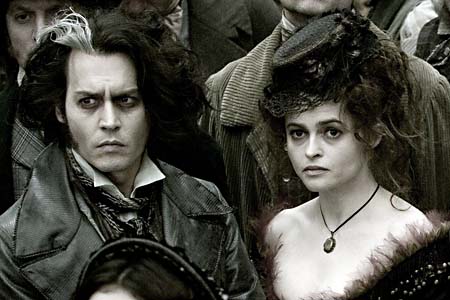
He is clearly a very disturbed character, unsurprisingly, after everything that has happened to him - not too long into the film Judge Turpin decides to marry Johanna - yet he is still attractive, particularly to Mrs Lovett, who fantasises about the two of them being together - something which plays a part in the twist in the film. What Todd wants most is revenge, and he strikes out at his corrupt aristocratic customers, killing a great deal of them, but he wants to get his hands on Turpin, the one who ruined his life. This desire, this need for revenge fuels his madness and he ceases to think about his actions, ultimately leading to his chilling demise at the end of the film, when he feels he has been betrayed and used by Mrs Lovett.
His relationship with her, though she would like it to be something more, is never seen by him to be a lot more than a matter of convenience and partnership in crime, because he will never stop loving Lucy, who is dead...
Todd is a very intriguing and, despite being a murderer, quite likeable character, as audience sympathy is created for him, as we know the whole story. The film is about him, and so he needs to have the qualities of creating this enigma, in order to attract the audience to want to find out more, which I feel it does very successfully.


Sweeney Todd & Mrs. Lovett

Monday, November 3, 2008

Genre - The Way It Goes

Cycle, Series, & Franchise
(in horror)

CYCLE
1960 - 'Psycho', 'Peeping Tom'
1974 - 'Texas Chainsaw Masacre', 'The Omen', 'The Amityville Horror', 'The Exorcist'
1978 - 'Halloween' -> Michael Myers
1980 - 'Friday the 13th' -> Jason
1984 - 'A Nightmare on Elm Street' -> Freddy Krueger
1991 - 'Silence of the Lambs'
1996 - 'Scream', 'I Know What You Did Last Summer'
2007 - 'Scary Movie'
The above is a demonstration of the way the popularity of a genre rises and falls in a cycle. 'Scary Movie' is a parody of the horror genre - usually parodies kill off the genre because they can no longer be taken seriously, but this is not necessarily true.

SERIES - when a horror film has been successful, sequels are very often made - using examples from the above line, there have been sequels to most of them, e.g. Scream, Scream 2, Scream 3, and filming for Scream 4 will start at the beginning of 2009.

FRANCHISE - after the series stage, when sequels have clearly been successful and audiences have continued to go to see them, products are often sold that relate to the film, or are copies of props in the film, e.g. you can buy the Scream mask...

Genre


*GENRE*

gen·re –noun
1. a class or category of artistic endeavor having a particular form, content, technique, or the like: the genre of epic poetry; the genre of symphonic music.
2. Fine Arts.
a. paintings in which scenes of everyday life form the subject matter.
b. a realistic style of painting using such subject matter.
3. genus; kind; sort; style. –adjective
4. Fine Arts. of or pertaining to genre.
5. of or pertaining to a distinctive literary type.


Genre - usually referring to books, films, TV programmes, video games...


  • grouping films by genre allows us to group them by similarities
  • depends on how it is made and what it is about - characteristics, key feature, conventions

Categories of Conventions:

Characters: typical roles, characteristics, relationships, action & behaviour, names, costume etc.

Narratives: typical plots/structures, events & how they happen

Themes: typical ideas behind the story, what the film is about, the director's intentions for the audience, ways of thinking that the film inspires

Iconography: mise-en-scène, props, locations, colours, shooting, lighting and techniques


There need to be enough films with similar characterstics and key features for a genre to be created, e.g. horror. Sub-genres can only develop once a genre is very large, e.g. Zombie films are a sub-genre of horror, as they have similar characteristics but their own defining features too.


The key to making any genre film successful is REPETITION and DIFFERENCE - directors take elements of previous successful films & insert twists and breaks with convention. A film will probably be unsuccessful if it is too similar to another.

Formula for a successful genre film = familiar combined with the unexpected. There needs to be familiarity, or audiences can become confused. Word-of-mouth can undo initial successes of films which fail to meet the conventions of the genre they claim to be.

Films that cross genres [hybrids] often have several different posters advertising the film, each portraying a different genre within the film.

Genre films are much easier to target and market en masse than non-genre films, due to the power of expectation amongst audiences. Non-genre films tend to be more difficult to decode & therefore be enjoyed, which is one thing that can limit their mainstream appeal.

For producers and directors, using genre conventions helps films have a higher popularity and familiarity with audiences, and helps them to target & market the film. The risk factor is reduced with the use of previously successful elements too.

For audiences, genres help inform what they like and therefore what films they want to see, which stems from the expectations of certain genres - as audience members, we know generally what we do and don't like and so tend to go for what we know when choosing films - we look for the familiar. These are called 'predictable pleasures'.

However, categories are not as stable as they look; there is not one for everything. Genre theory is useful but if you look at it too closely and try to play around with it too much, it doesn't really work.

Friday, October 31, 2008

Shock Shock Horror (Conventions)!

HAPPY HALLOWEEN!


I had to have a post on Halloween about something to do with horror, so here are some conventions of the horror genre...

ICONOGRAPHY
Mise-en-scène (lighting, setting, location, props, costume)
  • darkness, shadows
  • low-key lighting
  • attics, basements
  • long empty roads and corridors
  • deserted buildings
  • big houses
  • woods, forests - Gothic settings - remote places, crumbling/derelict buildings - castles, mountains
  • dark places
  • haunted places
  • the ordinary - home, school, etc.
  • knives
  • creepy toys
  • mirrors
  • curtains
  • cupboards
  • torches
  • guns - shotguns, pistols
  • fake heads, hands, body parts...
  • masks
  • gloves
  • chainsaws
  • calling card
  • candles
  • daggers
  • blood
  • villains - disguise - masks, cloaks etc., smart
  • victims - nice clothes, often inappropriate e.g. dresses and high heels, become torn , bloody
Framing & Camera-work
  • close-up range, ECUs
  • jump cuts
  • off-centre framing
  • dutch angles (rolling)
  • changing levels, LAs and HAs
  • tracking shots
  • pans, whip pans, and tilts
  • hand-held shots, shaky movement
  • ambiguous shots
  • POV shots
  • dark, slow movements followed by fast cuts

CHARACTERS

Personalities & Characteristics

  • victims
  • villains
  • lots of victims - high body count
  • personality extremes
  • [blonde], stupid, ditzy, pretty girl - victim
  • 'final girl' (the girl who starts out being terrified and screaming all the time, and then turns detective & works out what's going on etc., and is left alive at the end)
  • damsel in distress
  • the boyfriend/love interest
  • the clever guy
  • psychopaths
  • vampires
  • zombies
  • witches
  • possessed children/toys
  • spirits of children
  • children in general
  • ghosts
  • devil
  • demons
  • natural - animals/creatures, but with a paranormal twist?
  • stupidity - falling over, going towards creepy noises, not running away, locking themselves into small spaces with no escape and no weapon
  • young, beautiful people
  • teenagers
  • useless/corrupt police

Characters' Emotions & Feelings

  • doubt
  • vengeful - both victims and villains
  • confusion
  • panic
  • desperation

Habits & Behaviours

  • villains - may leave some kind of calling card
  • victims may have had a particular lifestyle or done something which incited the wrath of the villain, e.g. in James Wan's 2004 film Saw
  • obsessions by the villain with something/someone
  • when the film revolves around teenagers, partying, drinking, and drug-taking often occur & sometimes start of the film

Costume & Dress Codes

  • ditzy stupid girl - nice hair, makeup and clothes
  • female victims tend to be wearing nice clothes which are inappropriate for running away and hiding, e.g. dresses and high heels
  • makeup will get smudged, mascara will run, clothes will be torn
  • villains tend to disguise themselves; wear dark clothes
  • the clever people wear glasses

NARRATIVE

Plot & Motivation of Characters

  • someone's out for revenge
  • coincidence
  • being trapped somewhere alone with no help
  • murders & death
  • vengeance
  • obsession
  • jealousy
  • confusion
  • mental illness
  • love
  • hatred

Structure

  • closed narrative
  • starts off happy, ok, even jovial
  • people start dying or disappearing or weird things start happening
  • police [or similar] are useless/uninterested/corrupt & think it's a coincidence or nothing's wrong
  • some characters try and work out what's going on
  • things get progressively worse, more of them become unable to help either through disappearing/being killed/being injured/going crazy etc.
  • remaining character/s become determined to find out what's going on [e.g. the 'final girl'] because they can't just escape
  • either: - they die

- they work out what's going on [or do they?]

- they escape [or do they??]

- everything's ok [or is it??]

  • often things aren't tied up at the end completely, or all is not as it seems, to leave room for sequels if the film does well

Action & Events

  • running away
  • hiding
  • being saved
  • escaping
  • being trapped
  • murders
  • torture
  • psychological games
  • chases
  • discovery

Sounds (dialogue, music, etc.)

  • creaking
  • silence
  • screams
  • bumps
  • wind
  • weather
  • contrast between sounds
  • high pitched frenzied strings
  • constant/stopping & starting low pitched strings
  • maniacal laughter
  • howling
  • sudden bass drum noise
  • gunshots
  • scrabbling, scratching
  • breathing

THEMES

Ideas Underpinning The Story

  • love
  • obsession
  • jealousy
  • mental illness
  • twisted sexuality
  • [heroism]
  • possession
  • secrets
  • concealment
  • following, stalking, secretly watching, observing
  • claustrophobia
  • moral lessons
  • supernatural
  • being trapped
  • isolation
  • pursuit
  • traps
  • death
  • gore, gory detail
  • premonitions
  • lawlessness

Audience's Reactions & Emotions

  • visceral pleasures - quickened heartbeat, jumping
  • emotional pleasures
  • intellectual puzzles
  • fear
  • shock
  • panic
  • disgust and revulsion
  • anger
  • shouting at screen e.g. at stupid people who go towards creepy noises, or to tell them something...
  • tension